This weekend I went to "Origin of our Dreams" the Asian American Student Conference. Christie Heller de Leon was speaking (with Paul Tokunaga).
In the afternoon, I lead two workshops: one for Asian American women, and another for others ABOUT Asian American women.
The first session we discussed the accessories for life that our families, our campuses, society, and friends give us. In some ways we work hard to acquire the accessories for life that we think we'll need for the future--a specific degree, certain job experience, a significant other that reflects the life we want to grow into.
The second session had a pretty dynamic discussion. The men had a lot of questions to ask--it sounds like there's a lot of mystery and a lot of bites from Asian women. I appreciated the learning posture that so many men brought in. We talked about "what to Asian men do that makes the situation worse" and "How do you affirm Asian women--they get mad when I do, they get mad if I don't."
The thing that struck me is that so often, when we don't know what to do, we don't do anything at all. My exhortation to the guys was, "Try! Go out and get data! Each person is different, and you'll make loads of mistakes. Better to try and make lots of mistakes now, but be able to make educated guesses later."
I think there's a "curse of not-knowing" that paralyzes us from taking risks, especially in our Christian discipleship.
Tuesday, April 17, 2007


Monday, April 2, 2007
Success and failure after 30
While riding in a car with a few friends, the conversation jumped to every topic. We covered life, landscaping, love...but one comment sticks out.
"Success has nothing to teach a man after 30...."
We were talking about spiritual formation theory. My friend, Henry, a man in his 40s shared about some of the lessons and choices he was making. We talked about ascending and descending and spiritual journeys. And then this comment about success came out.
I've been thinking about it a lot and wondering what it means. Intuitively, it makes a lot of sense. But what does it reveal about the formation of non-whites or women? For Asian American women, for female Christians, is it success or failure, or stagnation that God uses to speak and shape us in this middle season?
I wondered about success and its connection to self-doubt. Tracey covers self-doubt well in her chapter on leadership. I continue to be surprised at the prevalance of self-doubt among many women leaders. How does God work with us in our self-doubt, and what does he use to shape us into people who understand the power of God? Is a ministry success part of understanding, for women, God's power...is it connected to the self-doubt that most women leaders experience. Or is it something else?
"Success has nothing to teach a man after 30...."
We were talking about spiritual formation theory. My friend, Henry, a man in his 40s shared about some of the lessons and choices he was making. We talked about ascending and descending and spiritual journeys. And then this comment about success came out.
I've been thinking about it a lot and wondering what it means. Intuitively, it makes a lot of sense. But what does it reveal about the formation of non-whites or women? For Asian American women, for female Christians, is it success or failure, or stagnation that God uses to speak and shape us in this middle season?
I wondered about success and its connection to self-doubt. Tracey covers self-doubt well in her chapter on leadership. I continue to be surprised at the prevalance of self-doubt among many women leaders. How does God work with us in our self-doubt, and what does he use to shape us into people who understand the power of God? Is a ministry success part of understanding, for women, God's power...is it connected to the self-doubt that most women leaders experience. Or is it something else?
Thursday, March 29, 2007
Spiritual Self-Esteem
I working on some material for a women's luncheon. The topic is "spiritual self-esteem" which is sort of an interesting topic. It seems to merge a couple the "Christian" side of me and the "western" side of me, but I wonder what role self-esteem plays in the Asian context.
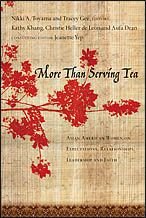
As I've been wandering around in various gender/culture/faith circles discussing issues raised by the book, I've had a growing conviction that its important to have men engaging on this issue. Our book often gets quickly relegated to the area of "women's ministry". I'm glad that its there, but Kathy raised the question, "When will people look at the issue of gender as a church health issue?"
One of our recent discussions "Navigating gender sub-cultures in your congregation" moved the gender discussion into a safer zone for both. I've felt more freedom talking about the subject of gender in academic settings. However, I'm still not sure how do you talk about gender dynamics in a church setting that doesn't marginalize or make people defensive.
As I've been wandering around in various gender/culture/faith circles discussing issues raised by the book, I've had a growing conviction that its important to have men engaging on this issue. Our book often gets quickly relegated to the area of "women's ministry". I'm glad that its there, but Kathy raised the question, "When will people look at the issue of gender as a church health issue?"
One of our recent discussions "Navigating gender sub-cultures in your congregation" moved the gender discussion into a safer zone for both. I've felt more freedom talking about the subject of gender in academic settings. However, I'm still not sure how do you talk about gender dynamics in a church setting that doesn't marginalize or make people defensive.
Tuesday, March 27, 2007
Asian Pacific American Book Festival

Nikki and I will be attending the Asian Pacific American Book Festival in May. If any of you are going to be in LA in May, please come! It looks to be a really interesting event with APA authors from all walks of life. I'll be on a panel with other APA authors who deal with spirituality.
Tuesday, March 20, 2007
Origins of our Dreams

Tuesday, March 13, 2007
Beauty
Check out this video from Dove:
It shows the transformation of a "normal" model into a billboard.
http://www.campaignforrealbeauty.ca/flat2.asp?id=7134
I love the line, "Not even supermodels look like supermodels." The part where they show the digital transformation of a photo was so interesting. I knew that photoshop was amazing, but it's interesting to see how the dramatic adjustments of the face create the ultimate beautiful face.
I've appreciated Kathy's definition of beauty in the chapter on sexuality in the book. She describes physical, spiritual, and emotional aspects of beauty (ie. compassion) that is so helpful.
"How beautiful are the feet of them that brings good news."
It shows the transformation of a "normal" model into a billboard.
http://www.campaignforrealbeauty.ca/flat2.asp?id=7134
I love the line, "Not even supermodels look like supermodels." The part where they show the digital transformation of a photo was so interesting. I knew that photoshop was amazing, but it's interesting to see how the dramatic adjustments of the face create the ultimate beautiful face.
I've appreciated Kathy's definition of beauty in the chapter on sexuality in the book. She describes physical, spiritual, and emotional aspects of beauty (ie. compassion) that is so helpful.
"How beautiful are the feet of them that brings good news."
Monday, March 12, 2007
Crying like a 7-year-old girl with a skinned knee
So, what does it mean when a man starts out by saying, "I cried like a 7-year-old girl with a skinned knee?" I'm really asking this. I've actually been asking this of many people ever since I saw a blog post start out with that line. I've been asking men and women, Asian American and not and my very unscientific poll shows women rolling their eyes and saying, "What?!" and men rolling their eyes and saying, "So what." Again, very unscientific. There were a number of men who did respond by saying, "What?!" and they all either work with me or, at least in one case, is married to me.
Having had to parent both a 7-year-old girl and a 7-year-old boy I can attest to the fact that both cry like mad when they skin their knees. The only difference is when the child (girl or boy) is told by the parent/authority figure to "stop crying". Have you ever skinned your knee? I'll never forget watching an acquaintance tell his son to "stop crying like a little girl". I made a mental note that afternoon to pray for that young boy's future wife.
It's a little comment, which on my "good girl" days I can let it slide. But I'm growing weary of being a "good girl". I love crying, connecting my soul and body to actually act out what it is feeling, experiencing. I want less to be "good" and want more to be "true" to the woman God intends me to be.
Now pass me a bandaid and some tissue, please.
Having had to parent both a 7-year-old girl and a 7-year-old boy I can attest to the fact that both cry like mad when they skin their knees. The only difference is when the child (girl or boy) is told by the parent/authority figure to "stop crying". Have you ever skinned your knee? I'll never forget watching an acquaintance tell his son to "stop crying like a little girl". I made a mental note that afternoon to pray for that young boy's future wife.
It's a little comment, which on my "good girl" days I can let it slide. But I'm growing weary of being a "good girl". I love crying, connecting my soul and body to actually act out what it is feeling, experiencing. I want less to be "good" and want more to be "true" to the woman God intends me to be.
Now pass me a bandaid and some tissue, please.
Subscribe to:
Posts (Atom)