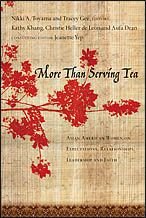
For those of you who've read the book, there are a few references to the death of my mother-in-law. After she died, my husband and I opened up our home and invited my father-in-law to move in with us. Let's just say I learned quite a bit about myself, about my father-in-law, about my husband, and about how you can take the man/woman out of Asia but you can't take the Asian out of the man/woman.
To help all of us make the transition, we emptied out what had become our family's favorite room - a room off to the side of the main floor that served as the previous owner's home office. We moved in my FIL's king size bed, a dresser, desk, bookcases, etc. to bring a touch of home and privacy.
Short of building a new master suite downstairs, it was the best we could do. And then we did the best we could do. I did the best I could do.
But at some point, the expectations (preparing separate Korean meals when the kids wanted spaghetti) and the realities (that I could barely get the spaghetti on the table, never mind the brown rice and kalbi-tang) collided. Peter and I realized that this was not a long-term solution.
Even my FIL felt the tension as he was used to being more the center of the family. Here in Libertyville the center of the family is always moving. One day it's Bethany getting ready for her ballet classes. The next day it's Corban and his lost lego piece.
My FIL has moved in with my sister-in-law. He tells people he would rather live in Chicago but he didn't want to be a burden to me. Yes, I physically cringed when I first heard that.
But, Peter and I are trying to move beyond unhealthy guilt, balance it with love for my FIL, and live.
So the room that was once the "tv room" and then became "halabujee's room" is becoming "my office". Peter and I tore out the ugly blue carpet to find a hardwood floor that needed some love. Peter lovingly sanded, poly-stinky-stained it, painted the trim and then last night helped me with the first coat of Pepper Grass green, eggshell finish. It was the first time I spent more than a few seconds in that room since the end of last year when we moved the last of my FIL's things out...
My office is now very green - vibrant, rich, full of hope and a little weird.
Thursday, February 22, 2007


Friday, February 16, 2007
Northwestern University

Come join us in Chicago. Kathy Khang and I will sit on a panel looking at the women and religion sponsored by Northwestern University.
Southern Cal Visit

We're just returning from a series of events at Azusa Pacific University and a reception in Los Angeles. Asifa and I attended a couple of days of events including a couple of classroom visits. Tracey and I sat on a panel with a couple of women from "Asian Amerian Women on Leadership". It was a great discussion.
During the day, I appreciated the questions that students raised. We had an honest conversation about modern-day racism and challenges of media stereotypes. A professor in social work, a Latina, made the connection that the discussions between the various racial groups have a lot of overlap. She's thinking about adding the book to her curriculum.
Yesterday morning, Mission Year President Leroy Barber informed me that they are including the book as part of their training curriculum.
Wednesday, January 31, 2007
Study of Asian American Women Work/Family Balance
*****************************************************************
I am an assistant professor of Women's Studies at the University of
Massachusetts , Amherst
American women balance work and family responsibilities. If you or someone
you know
would be available to participate in survey for this study, it would
greatly contribute to understanding the challenges and concerns of
this understudied group of women and their mothering and work
experiences.
http://www.questionpro.com/akira/TakeSurvey?id=567154
The study is supported by an American Association of University Women
Postdoctoral American Fellowship, a grant from theInstitute of Asian
American Studies at UMASS Boston and a research leave from UMASS
Amherst
The survey will be completely confidential.
Unfortunately, I cannot offer any remuneration, other than the
satisfaction of knowing that your participation will potentially help
to raise awareness and facilitate workplace practices and policy
initiatives to better serve
Asian American working families. In addition, you may find the
survey
itself enjoyable and useful for gaining a deeper understanding of your
own experiences and how they compare to other Asian American women.
At the end of the survey, you can enter your name into a raffle for a
$100 book gift certificate as well as provide your contact information
if you are willing to participate in a follow-up interview. Thanks
and best wishes!
Miliann Kang
Assistant Professor of Women's Studies University of Massachusetts,
Amherst
I am an assistant professor of Women's Studies at the University of
American women balance work and family responsibilities. If you or someone
you know
would be available to participate in survey for this study, it would
greatly contribute to understanding the challenges and concerns of
this understudied group of women and their mothering and work
experiences.
http://www.questionpro.com/akira/TakeSurvey?id=567154
The study is supported by an American Association of University Women
Postdoctoral American Fellowship, a grant from the
American Studies at UMASS Boston and a research leave from UMASS
The survey will be completely confidential.
Unfortunately, I cannot offer any remuneration, other than the
satisfaction of knowing that your participation will potentially help
to raise awareness and facilitate workplace practices and policy
initiatives to better serve
Asian American working families. In addition, you may find the
survey
itself enjoyable and useful for gaining a deeper understanding of your
own experiences and how they compare to other Asian American women.
At the end of the survey, you can enter your name into a raffle for a
$100 book gift certificate as well as provide your contact information
if you are willing to participate in a follow-up interview. Thanks
and best wishes!
Miliann Kang
Assistant Professor of Women's Studies University of Massachusetts,
Thursday, January 18, 2007
Here is an excerpt from a reader, Ashleigh. I thought she had a very interesting story, as well as very thoughtful engagement with the issues!
------------------------------------------------------------
Nikki,
I had read More Than Serving Tea during exam week
(for the record/curiousity's sake, I'm not AA but white).
Ashleigh
------------------------------------------------------------
Nikki,
I had read More Than Serving Tea during exam week
(for the record/curiousity's sake, I'm not AA but white).
At the end of my first year of college I started asking a lot of questions about race, and though other people looked at me funny and told me to chill, I realized it would be completely hypocritical for me to want men to care about me and for me to not try to understand the minority experience and what it might mean for me as a white person. In the middle of the beginnings of this journey I found InterVarsity and realized that was a good place for me to explore these things further/step out in leadership. Nearly two years later, I'm my chapter's M-E Team Leader, out of all things!
Then this past semester it's been interesting to see things swing back the other way-- as I've learned so much about ethnic reconcilation and justice, I've seen a lot of places I need to forgive/heal as a woman and a lot of what I see as gaps in the leadership/scholarship on gender issues. (Everyone focuses on the theological debate, when I see a need for egals to move forward by also discussing more practically what gender rec and justice from a biblical perspective might look like in various areas and how what we've already learned about ethnic rec/justice might help inform that conversation.)
I'm still in the middle of this part of my journey, and I'm not exactly sure where's it's going to go. I've struggled a lot trying to understand how we should stand for truth, when that would make us a source of major disunity. In fact, I think Eph will be part of my journey in some way, though I'm not entirely sure how. But many days I struggle to understand how the church should stand against evil principalities and powers when so much of the church isn't at a pt of understanding/wanting to. Part of what I saw in Eph last week was that somehow unity and being above these powers aren't antithetical (just as, for ex, community vs. outreach isn't supposed to be a real conflict). But I'm still grappling with what all of this looks like for me as an indiv, for the parachurch, for the church, etc.
Then this past semester it's been interesting to see things swing back the other way-- as I've learned so much about ethnic reconcilation and justice, I've seen a lot of places I need to forgive/heal as a woman and a lot of what I see as gaps in the leadership/scholarship on gender issues. (Everyone focuses on the theological debate, when I see a need for egals to move forward by also discussing more practically what gender rec and justice from a biblical perspective might look like in various areas and how what we've already learned about ethnic rec/justice might help inform that conversation.)
I'm still in the middle of this part of my journey, and I'm not exactly sure where's it's going to go. I've struggled a lot trying to understand how we should stand for truth, when that would make us a source of major disunity. In fact, I think Eph will be part of my journey in some way, though I'm not entirely sure how. But many days I struggle to understand how the church should stand against evil principalities and powers when so much of the church isn't at a pt of understanding/wanting to. Part of what I saw in Eph last week was that somehow unity and being above these powers aren't antithetical (just as, for ex, community vs. outreach isn't supposed to be a real conflict). But I'm still grappling with what all of this looks like for me as an indiv, for the parachurch, for the church, etc.
Ashleigh
A collection of questions
At book discussions, readings and other Q&A, these questions stick out.
Why did you choose these struggles for Asian American women? Do Asian women in Asian countries have the same struggles?
Women in the Asian diaspora have an interesting dilemna. When their families immigrated, gender roles froze in time. If they immigrated in 1950, their expectations of what a Asian woman froze in 1950. In Asia, these gender roles continue to redefine and evolve in response to changes in the society. Gender roles are dynamic. But, for immigrants watching their young women deviate from these roles (1950s, 1970s, 1920s), changes usually equates "becoming Americanized". It goes both ways. I watch Christian churches in Japan that are frozen singing the hymns that were popular when their pastor came to the US to go to seminary. You can't blame the parents for wanting their young daughters to retain their culture. Our book tries to address and redefine Asian Pacific Islander is more dynamic and fluid terms.
What creates the "friends/enemies" dynamic for Asian Pacific Islander (API) women?
Asifa does a great job in a chapter talking about friendships for API women. She talked about the friendship (and enemy) dynamic. It's weird what a "communal" mindset will do. Suzy might be a close friend--but parents use that same friend to set up the "impossible" standard that you will never achieve. Perhaps you are the impossible standard that alienates your friends. Its a weird dynamic when friendships are personal but also communal.
My favorite quote on this: "Can't you be like _________?" (Fill in the name of your nerd cousin, valedictorian friend, or other mother appointed rival.) Phoebe Eng, author of Warrior Lessons
You do a good job of breaking down images and stereotypes. But images are so powerful and important. What image would you hold up for Asian American women to grow into, strive for?
Good question. Christie did a great job of describing the image--challenging in a respectful way, strong and cognizant of others, etc. But I continue to mull over this...what image would capture the strength and resilence that comes from surviving struggles.
Why did you choose these struggles for Asian American women? Do Asian women in Asian countries have the same struggles?
Women in the Asian diaspora have an interesting dilemna. When their families immigrated, gender roles froze in time. If they immigrated in 1950, their expectations of what a Asian woman froze in 1950. In Asia, these gender roles continue to redefine and evolve in response to changes in the society. Gender roles are dynamic. But, for immigrants watching their young women deviate from these roles (1950s, 1970s, 1920s), changes usually equates "becoming Americanized". It goes both ways. I watch Christian churches in Japan that are frozen singing the hymns that were popular when their pastor came to the US to go to seminary. You can't blame the parents for wanting their young daughters to retain their culture. Our book tries to address and redefine Asian Pacific Islander is more dynamic and fluid terms.
What creates the "friends/enemies" dynamic for Asian Pacific Islander (API) women?
Asifa does a great job in a chapter talking about friendships for API women. She talked about the friendship (and enemy) dynamic. It's weird what a "communal" mindset will do. Suzy might be a close friend--but parents use that same friend to set up the "impossible" standard that you will never achieve. Perhaps you are the impossible standard that alienates your friends. Its a weird dynamic when friendships are personal but also communal.
My favorite quote on this: "Can't you be like _________?" (Fill in the name of your nerd cousin, valedictorian friend, or other mother appointed rival.) Phoebe Eng, author of Warrior Lessons
You do a good job of breaking down images and stereotypes. But images are so powerful and important. What image would you hold up for Asian American women to grow into, strive for?
Good question. Christie did a great job of describing the image--challenging in a respectful way, strong and cognizant of others, etc. But I continue to mull over this...what image would capture the strength and resilence that comes from surviving struggles.
Tuesday, January 16, 2007
Asian American Writers Congress to Set Groundwork for the 2007 Asian Pacific American Book Festival
Writers and Emerging Writers Are Encouraged to Attend Free Event at UCLA on May 13, 2006
Noted Asian and Pacific American (APA) authors, publishers and community leaders will gather to commence the first ever Asian American Writers Congress. The purpose of the Congress is to promote networks among APA writers, both emerging and published, and to set the groundwork for the 2007 Asian Pacific American Book Festival in Los Angeles.
The dialogue is open to the public and will take place at UCLA's James West Alumni Center on Saturday, May 13, 2006 from 10 a.m. to 3 p.m. and is a project of the Asian Pacific American Legal Center (APALC) and is co-sponsored by UCLA's Asian American Studies Center.
The Asian American Writers Congress will serve to gather these creative artists and also emerging writers who may not know how to effectively reach their readers. This free event will include speakers, a publishing panel, and a discussion with all attendees about their writing journeys. Input will also be solicited on how the 2007 festival can best promote literature either written by or about Asian Pacific Americans. Door prizes include books produced by the festival's advisory council members. Various writing organizations, publishers, and booksellers will have resource materials on display.
"APALC is committed to help Asian Pacific Americans participate in the democratic process, and that often begins with literacy," said Stewart Kwoh, president and executive director, Asian Pacific American Legal Center. "Writers chronicle our experiences. We must encourage the telling of our stories-and that may take the form of memoir, poetry, literary fiction, genres like mystery and science fiction, and even cookbooks. APALC is excited to partner with the creative artists in our communities to reach our audience in new and fresh ways."
Subscribe to:
Posts (Atom)